Most small businesses say their customer is "everyone". It feels safe. It's actually the most expensive answer there is, because a message written for everyone lands with no one.
STP is the cure. It stands for segmentation, targeting and positioning, and it's how you decide who you're really for.
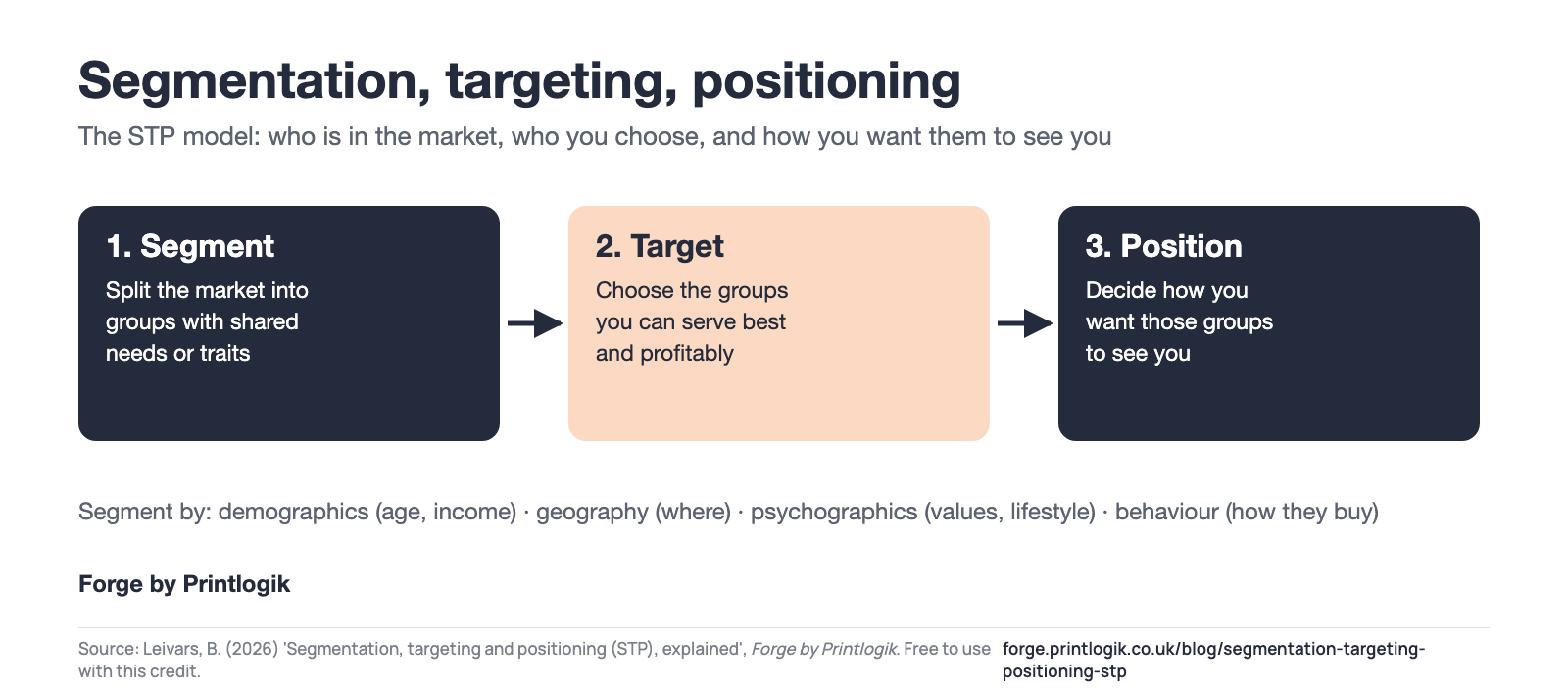
Use this diagram in your work
This diagram is free to download and use in essays, dissertations, presentations, coursework and teaching materials, and you are welcome to link to this article. All we ask is that you keep the source line on the image and reference this article. The references below are ready to copy.
Download this diagram (PNG, full size)
Harvard: Leivars, B. (2026) 'Segmentation, targeting and positioning (STP), explained', Forge by Printlogik, 14 November 2026. Available at: https://forge.printlogik.co.uk/blog/segmentation-targeting-positioning-stp (Accessed: date you accessed it).
APA 7th edition: Leivars, B. (2026, November 14). Segmentation, targeting and positioning (STP), explained. Forge by Printlogik. https://forge.printlogik.co.uk/blog/segmentation-targeting-positioning-stp
Figure caption: Figure 1: Segmentation, targeting and positioning (STP). Source: Leivars (2026), Forge by Printlogik.
Linking to this article: you are welcome to link to https://forge.printlogik.co.uk/blog/segmentation-targeting-positioning-stp from your work, reading lists, course pages or virtual learning environment.
Where it came from
The idea of market segmentation was set out by Wendell Smith in a 1956 article in the Journal of Marketing. He described it as adjusting what you offer to fit different groups of customers, rather than trying to bend all demand towards one product. Philip Kotler's textbooks later turned segmentation, targeting and positioning into the three-step model taught today.
Step 1: Segment
Split the market into groups whose members have something in common that affects how they buy. The four classic ways to segment are:
- Demographic: age, income, job, household. (See our guide to demographics in marketing.)
- Geographic: where they live or work.
- Psychographic: values, interests, lifestyle.
- Behavioural: how they buy, how often, and what they want from the product.
A good segment is big enough to be worth it, different enough to need its own approach, and reachable.
Step 2: Target
Now choose. You can't serve every segment well, so you pick the ones where you have an advantage and can make money.
A local gym might find three segments: students wanting cheap off-peak access, professionals wanting early-morning classes, and over-60s wanting low-impact sessions. It might target the professionals and the over-60s, because they fit its timetable and pay full price.
Step 3: Position
Positioning is the place you want to hold in your target customer's mind, compared with the alternatives. It's usually written as one sentence: for [target], we are the [category] that [main benefit], because [reason to believe].
For that gym: for busy professionals in the city centre, we're the gym that gets you trained and out in 45 minutes, because every class starts on time and finishes on time.
Everything else, from prices to posters, then has to back that sentence up.
The criticisms
- Segments are simplifications. Real people don't fit neatly into boxes, and data can make them look neater than they are.
- It can narrow you too far. Some researchers argue that brands grow by reaching more buyers of all kinds, not only a chosen few. It's a live debate, and a good essay will mention it.
Where print fits
Targeting is where print earns its keep. A flyer written for one segment and delivered to the streets where that segment lives will outperform a generic one sent everywhere. The same goes for postcards to an existing customer list, or posters in the places your target segment actually goes.
The short version
Segment the market into meaningful groups. Target the ones you can serve best. Position yourself so those people know exactly why you're the right choice. Then make everything you put out say the same thing.
How to cite this article (Harvard): Leivars, B. (2026) 'Segmentation, targeting and positioning (STP), explained', Forge by Printlogik, 14 November 2026. Available at: https://forge.printlogik.co.uk/blog/segmentation-targeting-positioning-stp (Accessed: date you accessed it).
Sources
- Smith, W.R. (1956) 'Product differentiation and market segmentation as alternative marketing strategies', Journal of Marketing, 21(1), pp. 3–8.