SWOT is probably the most used planning tool in business. It's also one of the most wasted. Most SWOTs end up as four lists of bullet points that nobody looks at again.
Used properly, it's a quick way to see where you stand before you decide what to do next.
Use this diagram in your work
This diagram is free to download and use in essays, dissertations, presentations, coursework and teaching materials, and you are welcome to link to this article. All we ask is that you keep the source line on the image and reference this article. The references below are ready to copy.
Download this diagram (PNG, full size)
Harvard: Leivars, B. (2026) 'SWOT analysis, explained', Forge by Printlogik, 17 November 2026. Available at: https://forge.printlogik.co.uk/blog/swot-analysis-explained (Accessed: date you accessed it).
APA 7th edition: Leivars, B. (2026, November 17). SWOT analysis, explained. Forge by Printlogik. https://forge.printlogik.co.uk/blog/swot-analysis-explained
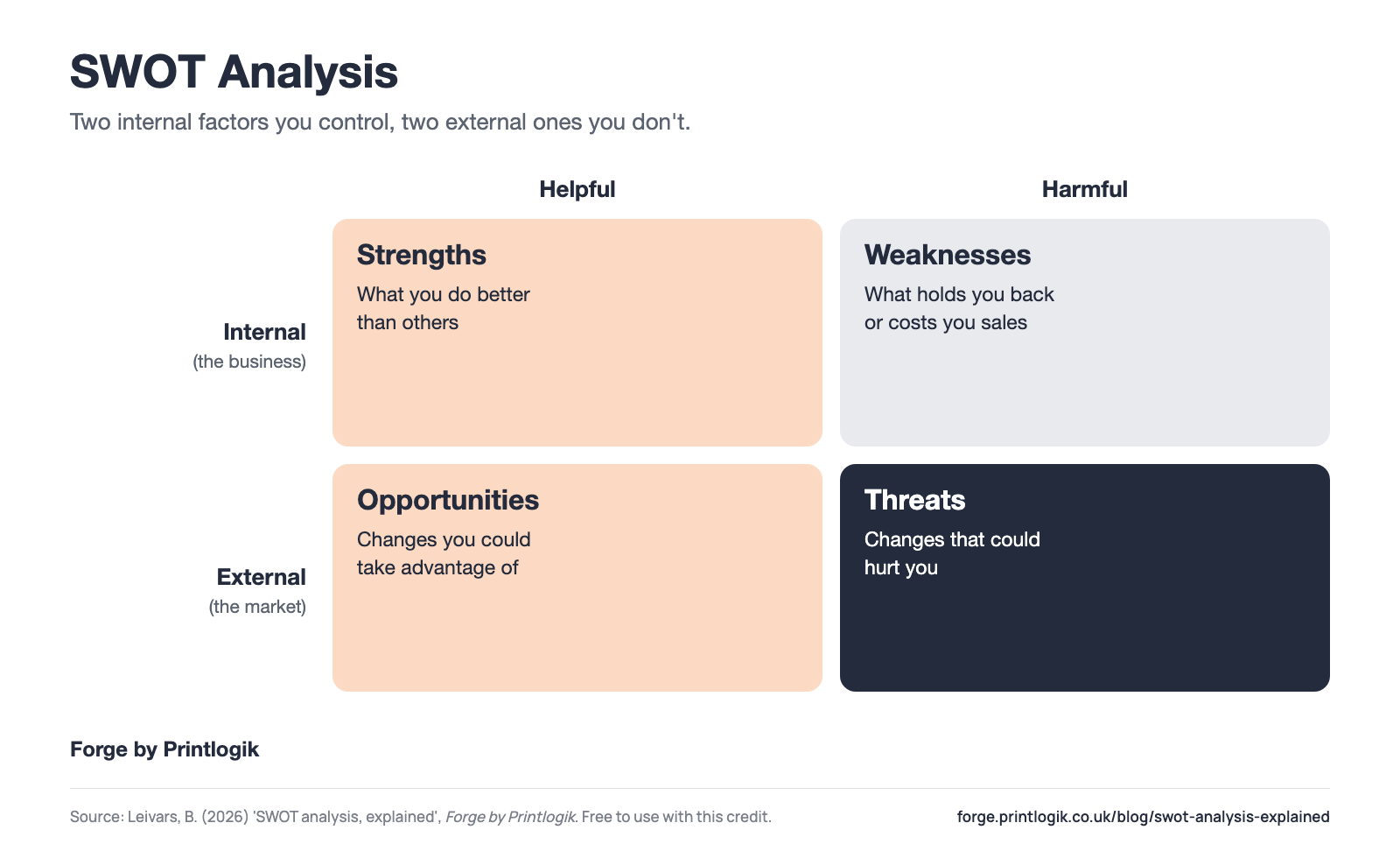
Figure caption: Figure 1: SWOT analysis. Source: Leivars (2026), Forge by Printlogik.
Linking to this article: you are welcome to link to https://forge.printlogik.co.uk/blog/swot-analysis-explained from your work, reading lists, course pages or virtual learning environment.
What goes in each box
The grid splits two ways. The top row is internal: things about your business that you control. The bottom row is external: things happening around you that you don't.
- Strengths. What you do better than the alternatives. A loyal customer base, a great location, a skill few others have.
- Weaknesses. What holds you back. A thin product range, slow delivery, one person doing everything.
- Opportunities. Changes in the market you could use. A new housing estate nearby, a competitor closing, a trend moving your way.
- Threats. Changes that could hurt you. Rising costs, a new rival, customers moving online.
The most common mistake is mixing these up. "We could start selling online" isn't an opportunity. It's an action. The opportunity is the thing that makes it worth doing, such as more of your customers buying online.
Where it came from
The honest answer is that it's disputed, and that's worth knowing if you're writing an essay.
Many textbooks credit four Harvard professors and their 1965 book Business Policy: Text and Cases (Learned et al., 1965). The book does discuss a company's strengths and weaknesses against its environment, but a 2023 study in Long Range Planning found it uses neither the SWOT acronym nor the grid (Puyt, Lie and Wilderom, 2023).
That study traces SWOT to a planning team led by Robert F. Stewart at the Stanford Research Institute. They published the "SOFT" approach in 1965, which became SWOT in 1967.
How to do one that's useful
- Be specific. "Good customer service" is in every SWOT ever written. "Most orders go out the same day" is a strength you can actually use.
- Compare, don't just describe. A strength only counts if it's stronger than your competitors'.
- Back it up. Use reviews, sales figures and what customers say, not just what the team thinks.
- Turn it into actions. Heinz Weihrich's TOWS matrix (Weihrich, 1982) does this by pairing the boxes: use strengths to grab opportunities, fix weaknesses that leave you open to threats, and so on.
A worked example
A small independent gift shop in Derby city centre:
- Strengths: a local, handmade range the chains don't stock, and owners who know their regulars by name.
- Weaknesses: no online shop, and quiet weekday footfall.
- Opportunities: more people wanting to "shop local" at Christmas, and corporate gift orders from nearby offices.
- Threats: rising rent and energy costs, and online marketplaces selling similar products for less.
Paired up, that points to a clear action. Use the handmade range (a strength) to win corporate gift orders (an opportunity), which also fills the quiet weekdays (a weakness).
The criticisms
- It's descriptive, not decisive. A 1997 study of how companies actually used SWOT found the lists were often too general and rarely used later in the planning process. The authors called it "time for a product recall" (Hill and Westbrook, 1997).
- The same thing can sit in two boxes. Being small is a strength (fast, personal) and a weakness (limited capacity).
- It's a snapshot. Markets change, so a SWOT from last year may be wrong today.
Where print fits
A SWOT often shows that a strength isn't being communicated. If your strength is a local, handmade range, it should be on your flyers, your business cards and in a short brochure or booklet you hand to corporate buyers. A strength nobody knows about doesn't win sales.
The short version
SWOT puts your strengths and weaknesses next to the opportunities and threats around you. Keep it specific, back it with evidence and turn it into actions. Otherwise it's just four lists.
How to cite this article (Harvard): Leivars, B. (2026) 'SWOT analysis, explained', Forge by Printlogik, 17 November 2026. Available at: https://forge.printlogik.co.uk/blog/swot-analysis-explained (Accessed: date you accessed it).
Sources
- Hill, T. and Westbrook, R. (1997) 'SWOT analysis: it's time for a product recall', Long Range Planning, 30(1), pp. 46–52.
- Learned, E.P., Christensen, C.R., Andrews, K.R. and Guth, W.D. (1965) Business Policy: Text and Cases. Homewood, IL: Richard D. Irwin.
- Puyt, R.W., Lie, F.B. and Wilderom, C.P.M. (2023) 'The origins of SWOT analysis', Long Range Planning, 56(3), 102304.
- Weihrich, H. (1982) 'The TOWS matrix: a tool for situational analysis', Long Range Planning, 15(2), pp. 54–66.