Every business that wants to grow faces the same question. Do we sell more of what we already do, or do something new? The Ansoff Matrix turns that question into four clear options, and shows you how risky each one is.
Use this diagram in your work
This diagram is free to download and use in essays, dissertations, presentations, coursework and teaching materials, and you are welcome to link to this article. All we ask is that you keep the source line on the image and reference this article. The references below are ready to copy.
Download this diagram (PNG, full size)
Harvard: Leivars, B. (2026) 'The Ansoff Matrix, explained', Forge by Printlogik, 14 November 2026. Available at: https://forge.printlogik.co.uk/blog/ansoff-matrix-explained (Accessed: date you accessed it).
APA 7th edition: Leivars, B. (2026, November 14). The Ansoff Matrix, explained. Forge by Printlogik. https://forge.printlogik.co.uk/blog/ansoff-matrix-explained
Figure caption: Figure 1: The Ansoff Matrix. Source: Leivars (2026), Forge by Printlogik.
Linking to this article: you are welcome to link to https://forge.printlogik.co.uk/blog/ansoff-matrix-explained from your work, reading lists, course pages or virtual learning environment.
Where it came from
Igor Ansoff, an applied mathematician turned business strategist, set out the idea in "Strategies for Diversification", published in the Harvard Business Review in 1957. He expanded it in his 1965 book Corporate Strategy. The neat two-by-two grid most textbooks show today is a later simplification of his original.
The four strategies
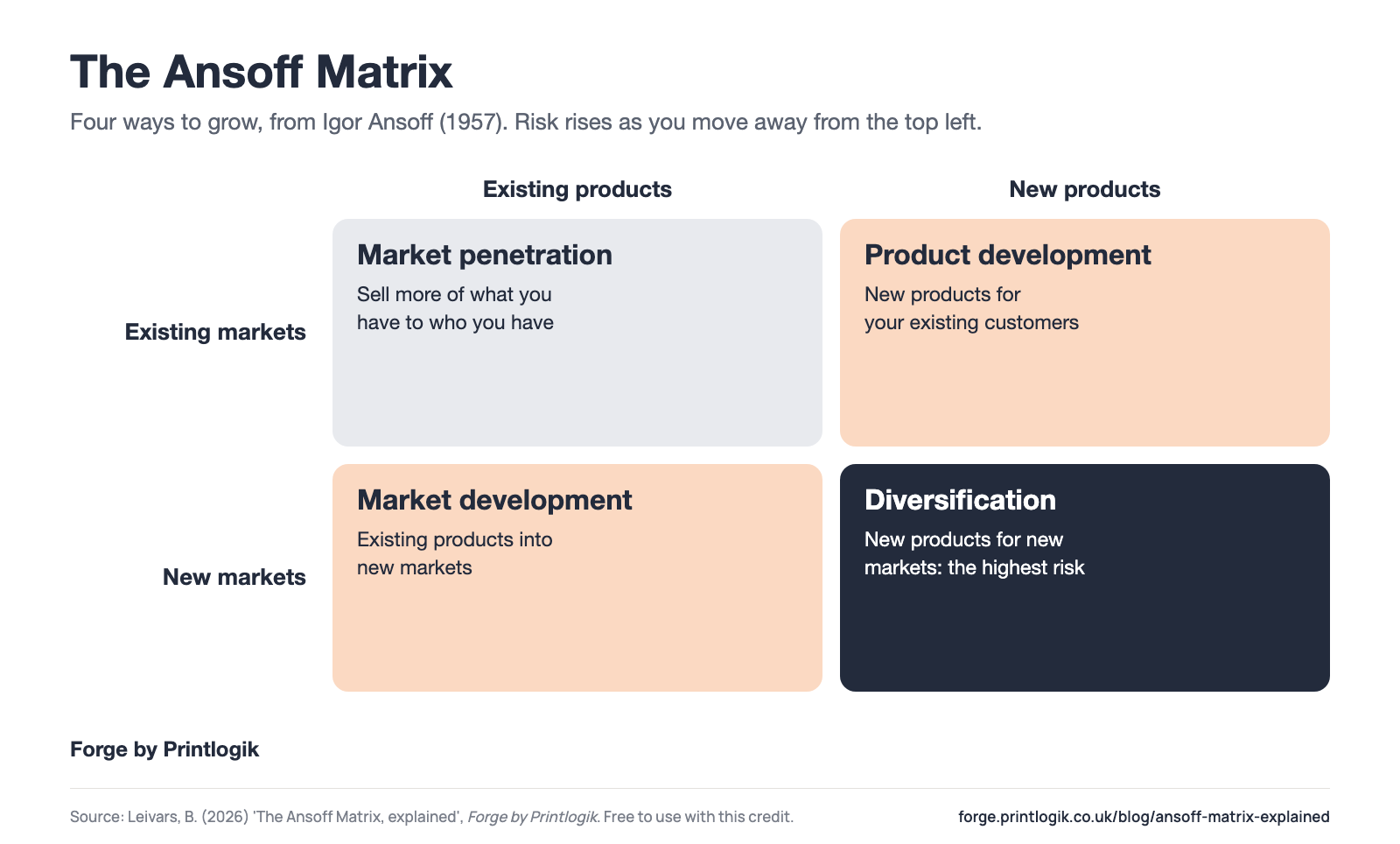
1. Market penetration: existing products, existing markets. Sell more of what you already sell to the kind of customers you already have. Loyalty schemes, promotions, better visibility and winning customers from competitors all count. It's the lowest-risk option because you know the product and you know the customer.
2. Market development: existing products, new markets. Take what you have to new customers. That could be a new area, a new type of customer (selling to businesses as well as consumers) or a new channel such as online.
3. Product development: new products, existing markets. Make something new for the customers you already know. A café that starts selling its coffee beans to take home is doing this.
4. Diversification: new products, new markets. Do something new for people you don't know yet. It has the most potential and the most risk, because you're learning two things at once.
How risky is each?
The usual rule is that risk rises as you move away from the top-left box. Penetration is the safest. Market development and product development each add one unknown. Diversification adds two.
That doesn't make diversification wrong. It means you should know why you're taking the risk and how you'll test it cheaply first.
A worked example
A small Derby bakery wants to grow.
- Penetration: a loyalty card and a weekday lunch deal for its existing customers.
- Market development: supplying sandwiches to local offices.
- Product development: celebration cakes to order for regulars.
- Diversification: baking classes for adults, a new product for a new audience.
Most businesses work through these roughly in that order, and the best plans often use more than one at once.
The criticisms
- It ignores competitors. The grid looks at your products and markets but says nothing about what rivals will do.
- "New" is a spectrum. A slightly different product or a neighbouring market isn't as risky as a completely new one, and the grid doesn't show that.
- It tells you the options, not the answer. You still need research to pick between them.
Where print fits
Each strategy needs different print. Penetration lives on loyalty cards, offers and flyers for people who already know you. Market development often means trade shows and new audiences, so a roller banner and good business cards do the introductions.
The short version
The Ansoff Matrix gives you four ways to grow: penetration, market development, product development and diversification. The further you move from what you know, the higher the risk. So start where you know the most, and test before you leap.
How to cite this article (Harvard): Leivars, B. (2026) 'The Ansoff Matrix, explained', Forge by Printlogik, 14 November 2026. Available at: https://forge.printlogik.co.uk/blog/ansoff-matrix-explained (Accessed: date you accessed it).
Sources
- Ansoff, H.I. (1957) 'Strategies for diversification', Harvard Business Review, 35(5), pp. 113–124.
- Ansoff, H.I. (1965) Corporate Strategy: An Analytic Approach to Business Policy for Growth and Expansion. New York: McGraw-Hill.