Most businesses don't fail because of something that happened inside them. They fail because the world moved and they didn't notice in time.
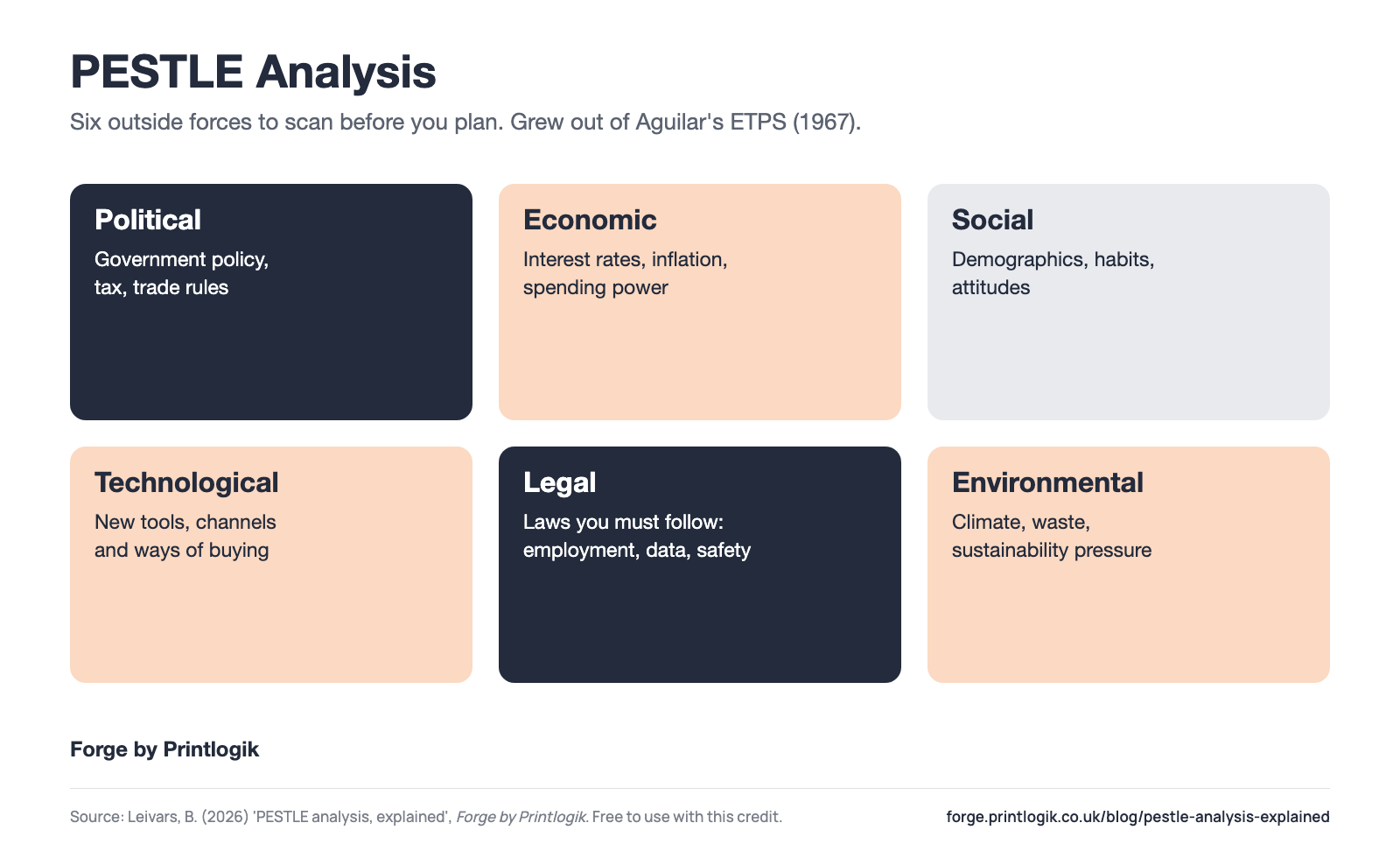
PESTLE is a checklist for noticing. Six headings, each one a different kind of outside force.
Use this diagram in your work
This diagram is free to download and use in essays, dissertations, presentations, coursework and teaching materials, and you are welcome to link to this article. All we ask is that you keep the source line on the image and reference this article. The references below are ready to copy.
Download this diagram (PNG, full size)
Harvard: Leivars, B. (2026) 'PESTLE analysis, explained', Forge by Printlogik, 20 November 2026. Available at: https://forge.printlogik.co.uk/blog/pestle-analysis-explained (Accessed: date you accessed it).
APA 7th edition: Leivars, B. (2026, November 20). PESTLE analysis, explained. Forge by Printlogik. https://forge.printlogik.co.uk/blog/pestle-analysis-explained
Figure caption: Figure 1: PESTLE analysis. Source: Leivars (2026), Forge by Printlogik.
Linking to this article: you are welcome to link to https://forge.printlogik.co.uk/blog/pestle-analysis-explained from your work, reading lists, course pages or virtual learning environment.
The six factors
- Political. What government does: policy, tax, trade rules, funding schemes.
- Economic. The money around you: interest rates, inflation, wages, how much customers can spend.
- Social. How people live and think: demographics, habits, attitudes, what's fashionable.
- Technological. New tools and new ways of buying: online ordering, payment methods, AI, automation.
- Legal. The laws you must follow: employment law, consumer rights, data protection, health and safety.
- Environmental. Climate, weather, waste, and growing pressure from customers to be more sustainable.
Political and legal often get confused. A simple rule: political is what the government is thinking about or changing, legal is what's already law.
Where it came from
The idea goes back to Francis Aguilar, a Harvard Business School professor. In his 1967 book Scanning the Business Environment, he grouped the outside world into four areas: economic, technical, political and social, often shortened to ETPS (Aguilar, 1967).
Later writers rearranged the letters into STEP and then PEST, and added legal and environmental to make PESTLE. You'll also see STEEPLE, which adds ethics. Nobody can point to a single moment PESTLE was invented, so if you're writing about it, cite Aguilar as the origin and describe PESTLE as a later extension.
How to do one that's useful
- Only list what affects you. A national policy that doesn't touch your customers doesn't belong in the analysis.
- Say what it means. "Inflation is high" is a fact. "Customers are trading down to cheaper options, so our mid-range line is at risk" is an insight.
- Look ahead. The point is to spot change early. Ask what's likely in the next one to three years, not just what's true now.
- Feed it into a SWOT. PESTLE finds the outside changes. SWOT sorts them into opportunities and threats and puts them next to your strengths and weaknesses.
A worked example
A small online candle business selling across the UK:
- Political: changes to small business rates or VAT thresholds affect margins.
- Economic: when budgets are tight, people still buy small treats, but they compare prices more.
- Social: gifting and "self-care" purchases are part of how many people shop.
- Technological: most sales come through phones, so the website has to work well on a small screen.
- Legal: candles need the right safety labelling, and online sales come with consumer rights on returns.
- Environmental: customers increasingly ask about packaging, wax type and recyclability.
The environmental and social points together suggest an action: plastic-free, recyclable packaging that looks good enough to give as a gift.
The criticisms
- It can turn into a list of everything. Without focus, a PESTLE gets long and says little.
- The headings overlap. A new packaging law is legal, political and environmental at once. That's fine. Put it where it matters most.
- It doesn't tell you what to do. It's an input to planning, not the plan.
- It goes out of date quickly. It needs revisiting, especially in fast-moving markets.
Where print fits
PESTLE often shows a change in how customers want to hear from you. Environmental pressure might mean switching to recyclable mailer boxes. A social shift towards shopping local might mean posters in the places your customers already go, and flyers for the streets around you.
The short version
PESTLE scans six outside forces: political, economic, social, technological, legal and environmental. Keep only what affects you, say what it means, and feed it into a SWOT so it turns into action.
How to cite this article (Harvard): Leivars, B. (2026) 'PESTLE analysis, explained', Forge by Printlogik, 20 November 2026. Available at: https://forge.printlogik.co.uk/blog/pestle-analysis-explained (Accessed: date you accessed it).
Sources
- Aguilar, F.J. (1967) Scanning the Business Environment. New York: Macmillan.