Most people pick an envelope size by holding up whatever's in the drawer. Then the letter doesn't fit, or it fits but costs more to post than it needed to.
There's a simpler way. Start with what's going inside.
The short version
- DL (220 × 110mm) takes an A4 sheet folded in three. It's the standard business letter envelope.
- C5 (229 × 162mm) takes an A5 sheet flat, or A4 folded once.
- C4 (324 × 229mm) takes A4 flat, with no folds at all.
The names come from the paper sizes. A C5 envelope is made to hold A5. A C4 holds A4. DL is the odd one out, sized for a sheet folded into thirds.
When to use each one
DL is for everyday post: invoices, statements, letters, and anything printed on your letterhead. Folding in three is what most people expect from a business letter, and it keeps the envelope slim.
C5 suits cards, A5 leaflets, and A4 documents you'd rather fold once than twice. Thank-you cards and invitations usually end up here.
C4 is for anything that shouldn't be folded: contracts, certificates, brochures and reports. If it's going to be signed, framed or filed, send it flat.
The size changes the postage
This is the bit that catches people out.
Royal Mail prices post by size as well as weight. A Letter can be up to 24 × 16.5cm, 5mm thick and 100g. A Large Letter can be up to 35.3 × 25cm, 2.5cm thick and 750g.
DL and C5 both fit within the Letter size. C4 doesn't, so it always goes as a Large Letter, and a Large Letter costs more to send.
So if you're mailing a few hundred A4 letters, folding them into a DL or C5 can make a real difference to the postage bill. Keep an eye on weight too. A few sheets of heavier paper can tip a Letter over 100g.
Our UK paper weight and mailing cost guide works out the weight of your mailing and whether it's a Letter or a Large Letter.
Window or no window?
A window shows the address printed on the letter inside, so you don't have to address each envelope. It's the quickest option for invoices and statements.
If you choose a window, keep your design clear of it. On a plain envelope, leave room on the front for the address to be printed or labelled.
Putting your name on it
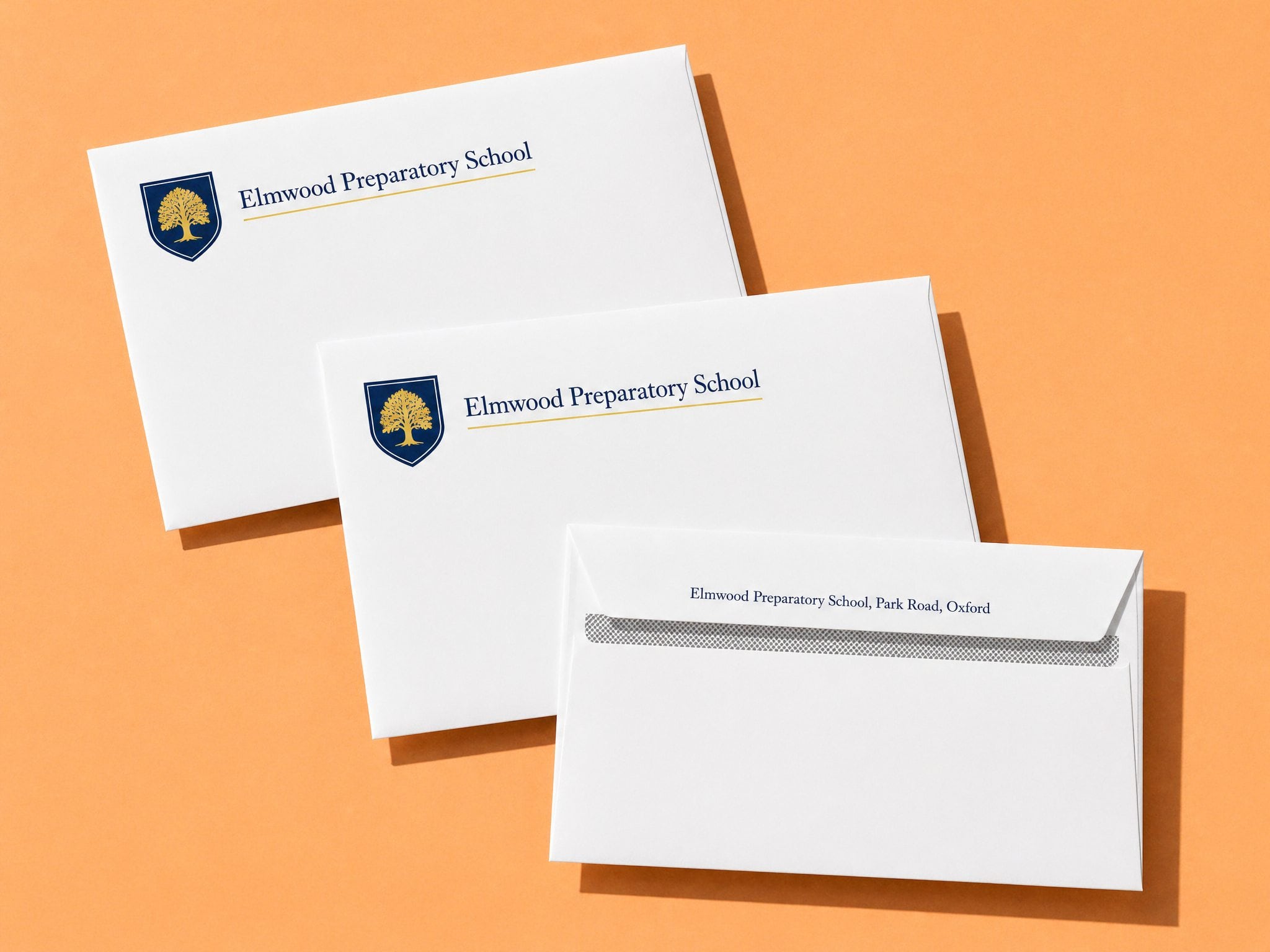
A printed envelope tells people who the post is from before they open it. Your logo and return address on the front is often enough. Some businesses print the back as well.
Our envelopes are white self-seal, in DL, C5 and C4, printed in black or full colour, with or without a window. A real person checks every file before it's printed.