People overcomplicate distribution channels. The textbooks give you levels, intermediaries and channel conflict, and by page three you've forgotten the question.
The question is simple. How does your product get from you to the person who buys it? That route is your distribution channel.
Use this diagram in your work
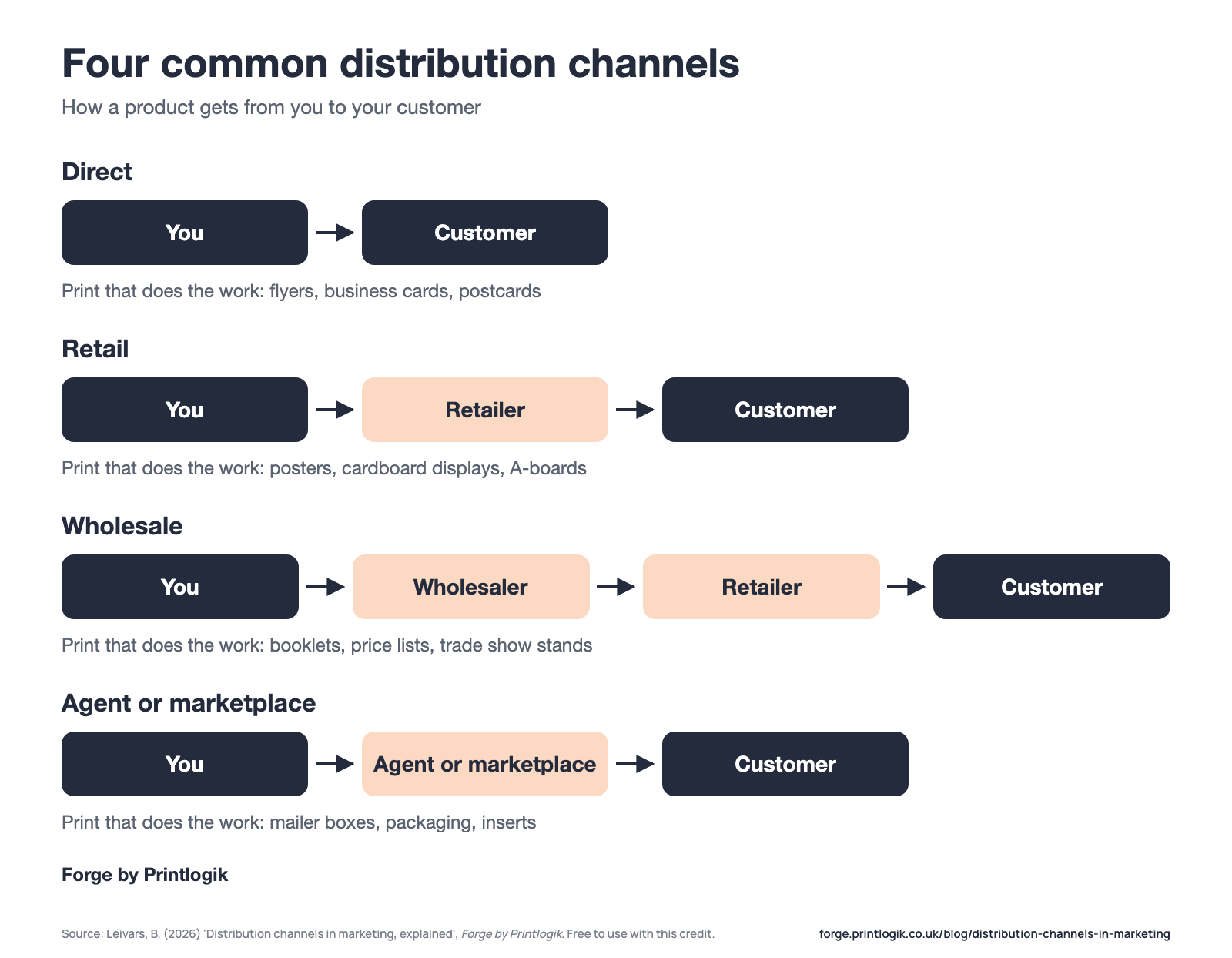
This diagram is free to download and use in essays, dissertations, presentations, coursework and teaching materials, and you are welcome to link to this article. All we ask is that you keep the source line on the image and reference this article. The references below are ready to copy.
Download this diagram (PNG, full size)
Harvard: Leivars, B. (2026) 'Distribution channels in marketing, explained', Forge by Printlogik, 14 November 2026. Available at: https://forge.printlogik.co.uk/blog/distribution-channels-in-marketing (Accessed: date you accessed it).
APA 7th edition: Leivars, B. (2026, November 14). Distribution channels in marketing, explained. Forge by Printlogik. https://forge.printlogik.co.uk/blog/distribution-channels-in-marketing
Figure caption: Figure 1: Four common distribution channels. Source: Leivars (2026), Forge by Printlogik.
Linking to this article: you are welcome to link to https://forge.printlogik.co.uk/blog/distribution-channels-in-marketing from your work, reading lists, course pages or virtual learning environment.
The four common channels
1. Direct: you to the customer
You sell straight to the person who uses it. A hairdresser, a plumber, an online shop selling its own products, a brewery taproom.
You keep all the margin and all the customer contact. You also do all the selling yourself, which is the catch.
2. Retail: you, a retailer, then the customer
You sell to a shop, and the shop sells to the customer. A local bakery supplying a farm shop. A candle maker with stock in three gift shops.
You get reach you couldn't get alone. You give up some margin, and you lose most of the contact with the people actually buying.
3. Wholesale: you, a wholesaler, a retailer, then the customer
You sell in bulk to a wholesaler, who sells on to lots of retailers. This is how most of what's on a supermarket shelf gets there.
It's the longest chain and the hardest to influence, because two businesses stand between you and the buyer. It's also how small makers end up in hundreds of shops at once.
4. Agent or marketplace: you, a middleman, then the customer
Someone else finds the customer for you. A marketplace like Etsy or Amazon, a sales agent working on commission, a booking platform.
You get access to their audience in exchange for a fee or a cut. The customer often thinks they bought from the platform, not from you.
Most businesses use more than one
It isn't a pick-one decision. A coffee roaster might sell direct from its website, wholesale to cafés, and through a marketplace at Christmas. That's normal.
What matters is knowing which channel each sale came through, because each one needs different support.
How to choose
Three questions do most of the work:
- How much contact do you need with the buyer? If your product needs explaining, or you live on repeat custom, stay close: direct.
- How fast do you need reach? If you need to be in a lot of places quickly, a retailer or wholesaler gets you there faster than you could alone.
- What margin can you give away? Every step in the chain takes a share. Work out what's left before you sign up.
Where print fits in each channel
This is the part people forget. The further your product travels from you, the more your print has to speak for you, because you aren't there.
- Direct. You're doing the selling, so print backs you up: flyers, business cards and postcards that go home with the customer.
- Retail. The shop staff won't sell your product the way you would. Posters, cardboard displays and A-boards do that job on the shop floor.
- Wholesale. Your buyer is a business choosing what to stock. A tidy booklet or price list, and a roller banner at the trade show, make that decision easier.
- Agent or marketplace. The packaging is often the first time the customer sees your name. A printed mailer box and an insert with your website on it turn a marketplace sale into someone who can find you directly next time.
The short version
A distribution channel is just the route from you to your customer. There are four common ones: direct, retail, wholesale, and agent or marketplace. Most businesses use more than one.
Choose by how close you need to be to the buyer, how fast you need reach and how much margin you can give up. Then make sure your print does the talking wherever you can't.